
Ward County Criminal Court Cases
Ward County uses several courts rather than one criminal division. Felonies proceed in the 143rd Judicial District Court, a district that also serves Reeves and Loving Counties. The District Clerk is custodian of the filed felony case record. Class A and Class B misdemeanors belong in Ward County Court and are kept by the County Clerk. Ward County has no county court at law, so there is no extra court layer to search between those two offices.
Fine-only cases stay lower in the system. Justice of the peace courts handle citation matters and magistrate work, while Monahans Municipal Court handles city ordinance, parking, and Class C matters within its reach. The court named on a citation or charging instrument controls. A sheriff booking record may show the charge received at intake, but it cannot identify the final court result. The filed case is the source for the prosecutor's chosen charge, plea, orders, judgment, and sentence.
Ward County Felony Files in District Court
The official 143rd District Court page identifies the court that hears Ward County felony cases. Its clerk file is distinct from the judge's chambers and the court administrator's work. Ordinary copy and inspection questions should go to the District Clerk, not to the judge or court administrator. Judge Alan Nicholas began serving this three-county district in 2025, but the custodian remains the clerk.
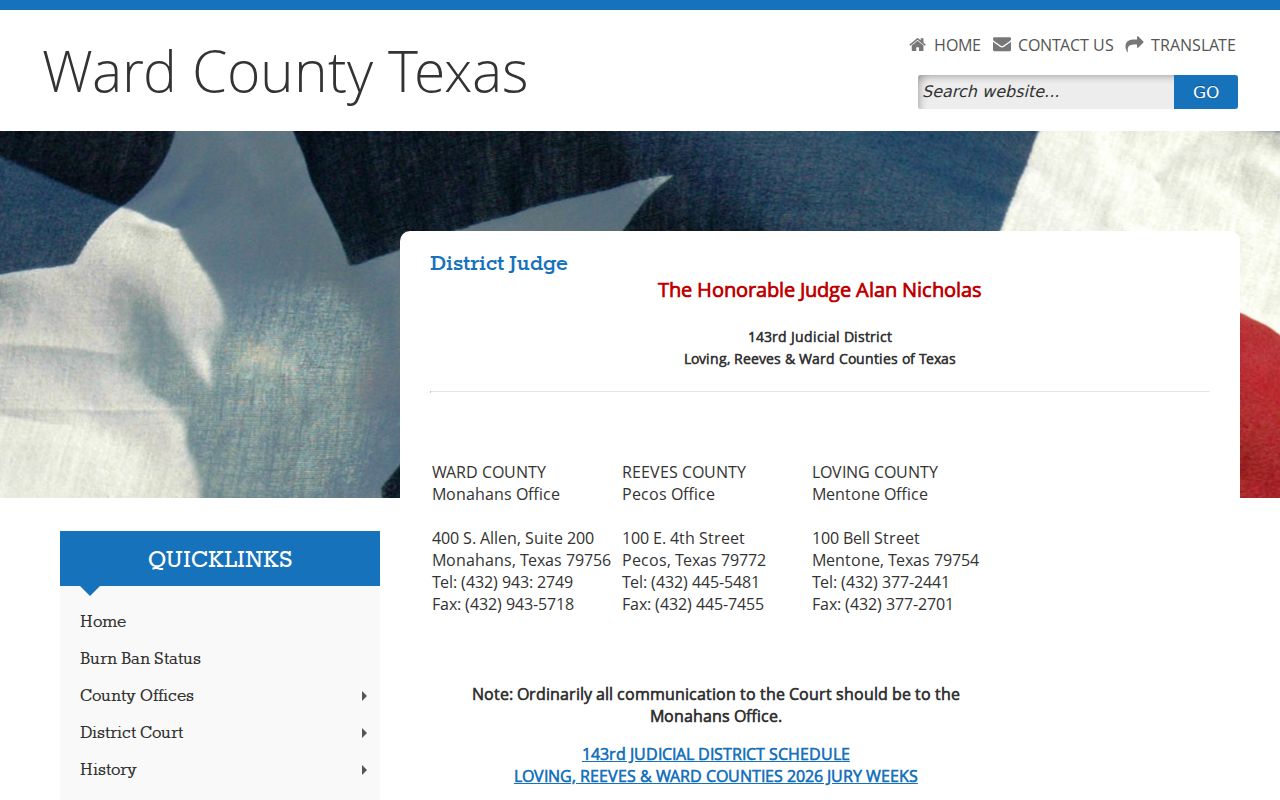
The captured court page helps a reader confirm the correct court before asking for a felony docket. The District Clerk counter is at 400 S. Allen Avenue, Suite 202, Monahans, TX 79756, and the office can be reached at 432-943-2751. Court Suite 200 and the court phone are not substitutes for the clerk's records counter.
Searching Ward County Case Records
No verified online Ward County criminal-case search exists. The reliable process begins with a name, a rough filing year, and a cause number when known. Contact the office for the likely charge level, confirm whether the file is on-site, and ask how inspection or copies can be arranged. Staff may help locate the right cause, but the County Clerk warns that the office is not required to conduct broad searches. A visitor may need to inspect the available index or material personally.
- Identify the likely court from the offense level or the issuing court printed on the citation.
- Call the District Clerk at 432-943-2751 for a felony, or the County Clerk at 432-943-3294 or 432-943-3295 for a Class A or B misdemeanor.
- Give the full name, approximate filing year, and cause number if one is available. Ask whether an older original must be recalled.
- Inspect the docket and charging instrument before drawing a conclusion about the outcome.
- Request the judgment, sentence, and any needed certified copy from the clerk that holds the case.
The local inquiry fields below reflect Ward County's documented clerk workflow. They are locating details, not a claim that the county runs a public web form.
| Field Label | Type | Required | Ward County Note |
|---|---|---|---|
| Party name | Full legal name | Yes | Ask about spelling variations |
| Cause number | Court-assigned number | If known | Best exact locator |
| Filing year | Approximate year | If known | Useful for common names |
| Charge level | Felony, A/B, or fine-only | For routing | Do not infer it from arrest alone |
| Copy type | Plain or certified | When ordering | Ask before paying for certification |
Two Ward County Criminal Case Counters
The Ward County District Clerk page supplies the felony-record counter information, mailing address, filing rules, and preservation notice.
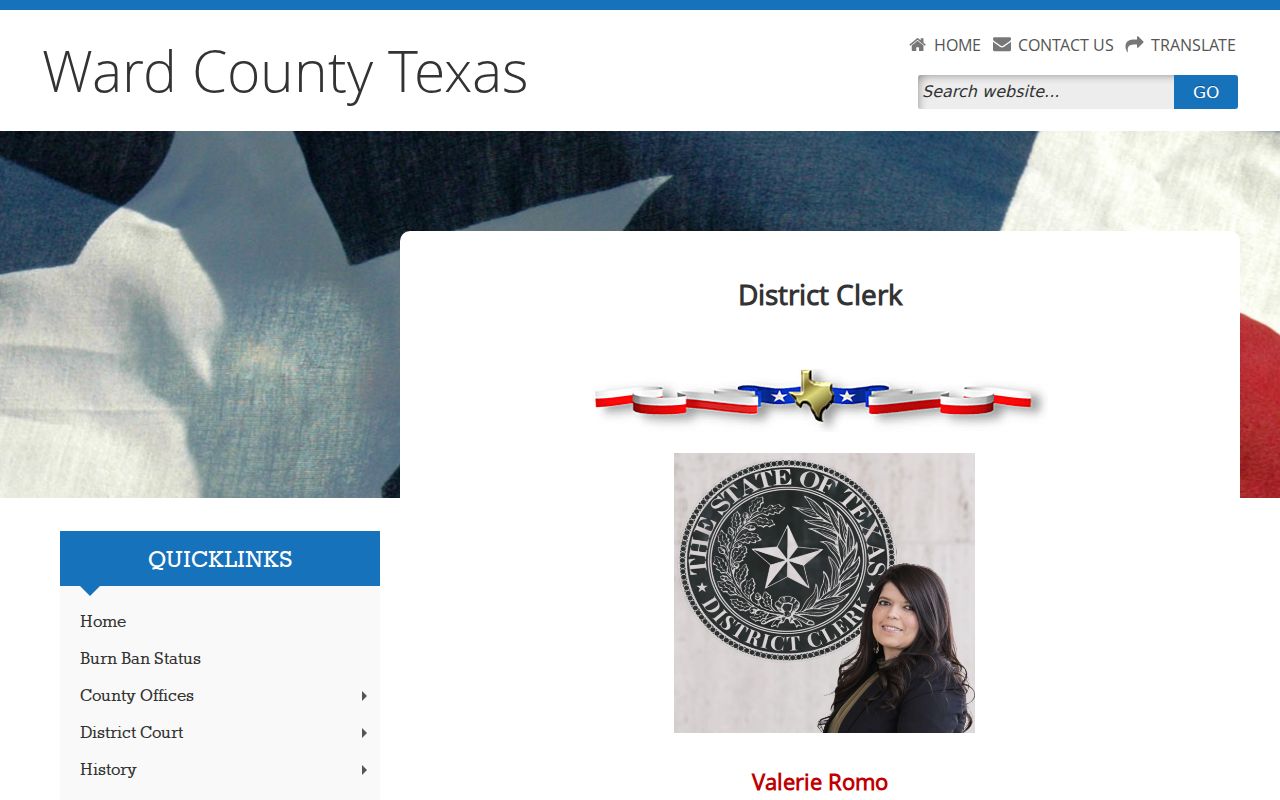
This source confirms that Suite 202 is the correct records location for district cases. Some originals are held by an off-site preservation company. Staff can request those files, often with a return in about one day, though the office does not promise a fixed turnaround when volume or the vendor causes delay. Official filings go through eFileTexas or U.S. mail and are not accepted by fax or email. A copy request is different from filing a pleading, so callers should ask what copy channel is currently accepted.
The Ward County Clerk page defines the other criminal counter and its limits.
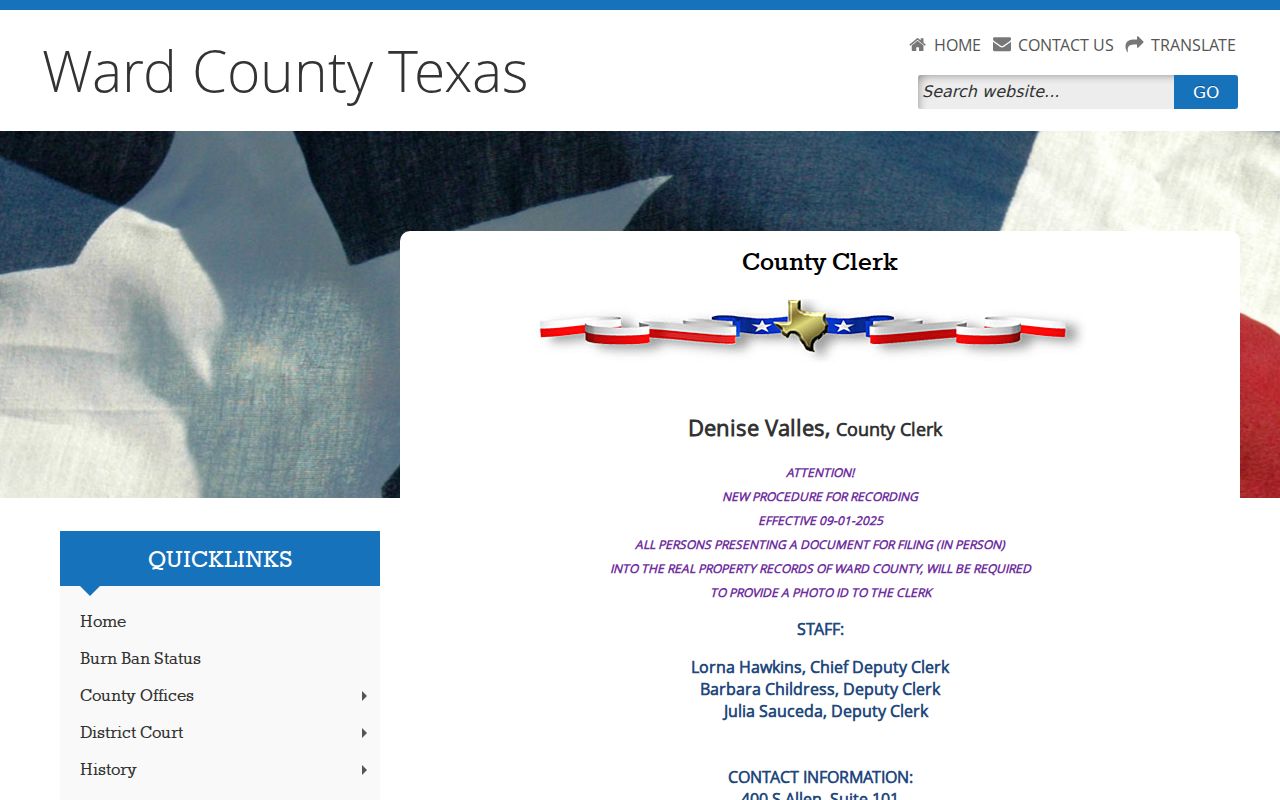
The County Clerk sits in Suite 101 of the same courthouse and keeps county-court misdemeanor records. It does not handle felonies or traffic tickets, and its linked online portal concerns land records. Public counter hours are 8:00 a.m. to 4:30 p.m. Monday through Thursday and 8:00 a.m. to 4:00 p.m. Friday. These two images show why the office name must be checked before a trip.
Inside a Ward County Case File
A complete Ward County court file is more than the docket sheet. The docket is the running event list, but the charging instrument states the accusation and the judgment records the court's result. Ask for the pieces that answer the specific question. If the issue is whether a charge changed, compare the complaint or booking label with the later information or indictment. If the issue is the outcome, find the signed judgment and sentence rather than relying on a status label alone.
| Cause Number and Court | Identifies the exact Ward County case, court level, and file. |
|---|---|
| Charging Document | The complaint, information, or indictment states the filed accusation and offense level. |
| Docket Entries | Lists filings, settings, hearings, orders, and other case events in date order. |
| Hearing Details | May show scheduled dates, appearances, counsel, pleas, and court action. |
| Disposition and Judgment | Records dismissal, acquittal, deferred adjudication, conviction, or another formal result. |
| Sentence and Costs | Can show confinement, community supervision, fines, restitution, court costs, and conditions. |
Counsel, bond entries, motions, linked warrants, and appellate notices may also appear. A plain copy can be enough for personal review, while an official use may call for certification. Confirm that need before ordering the more formal copy.
re:SearchTX Excludes Ward County Criminal Cases
The re:SearchTX portal is a statewide court-document system, but the Texas Judicial Council reports that its public corpus does not include criminal case records. It must not be presented as a Ward County criminal docket search. Registration or a visible search interface does not change that scope. The County Clerk's linked portal is also not a criminal search because it covers land records.
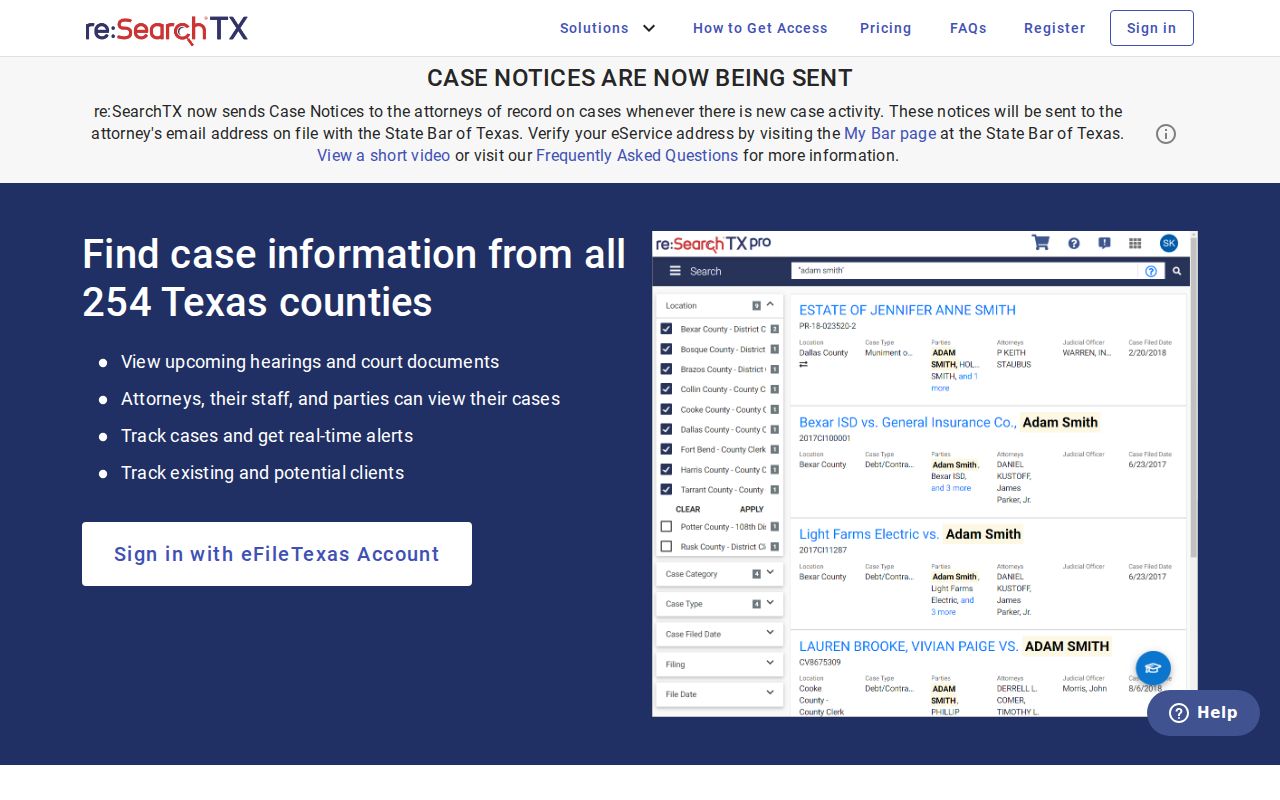
The screenshot is useful as a boundary marker: seeing a statewide court portal does not mean the desired criminal file is there. Ward County searchers should return to the local clerk workflow. Texas appellate systems may hold an appeal from a criminal judgment, but the trial-level pleadings and signed disposition still begin with the Ward County clerk.
How a Criminal Case Moves
A booking begins the custody record, not the final prosecution. Texas law calls for magistration without unnecessary delay and no later than 48 hours. The prosecutor then chooses whether and what to file. A felony commonly advances through a grand-jury indictment in the 143rd District Court. A Class A or B misdemeanor may proceed by complaint and information in Ward County Court. Arraignment, motions, plea talks, and trial settings follow in the case docket.
Case flow: Charges Filed › Arraignment › Pretrial › Plea or Trial › Disposition › Sentencing
A case can leave that line at several points. A prosecutor may decline or dismiss a charge. A grand jury may return a no-bill, meaning it declined to indict. A trial may end in acquittal. A plea or verdict can lead to conviction and sentence. The Ward County arrest lookup can establish the earlier custody trail, but only the clerk file supplies these later court events.
Reading Ward County Case Dispositions
Disposition terms prevent common mistakes when reviewing Ward County court records. A dismissal means the prosecution ended without a conviction on that charge, but it does not by itself erase the arrest. An acquittal is a not-guilty result. Deferred adjudication places a person on supervision without an upfront judgment of guilt, yet Texas may still report it publicly unless a valid nondisclosure order restricts release.
- No-bill
- A grand jury declined to return an indictment on the proposed felony charge.
- Information
- A prosecutor-filed charging paper commonly used for a misdemeanor case.
- Indictment
- The grand jury's formal felony accusation, not a finding of guilt.
- Deferred adjudication
- Supervision without an initial conviction judgment, subject to later dismissal or adjudication.
- Disposition
- The formal recorded outcome of a charge or case.
Read each result at the charge level. One cause may contain more than one count, and the counts may end differently. The signed judgment and docket should agree; if they do not, ask the clerk which document controls and whether a corrected entry exists.
Case Record Access & Restrictions
Ward County judicial files are generally inspected through the clerk's court-record procedure rather than treated as an ordinary executive-agency request under the Texas Public Information Act. The distinction matters because the clerk is the judicial custodian. Public copies can redact Social Security numbers, driver's-license and account data, protected victim information, minor identities, and other sensitive fields. Grand-jury deliberations remain secret even when an indictment itself is public.
Juvenile matters, expunged records, and material restricted by a nondisclosure or sealing rule will not become public just because a name is supplied. Active or sealed warrants can also be withheld. Texas Government Code Chapter 411 separates criminal-history repository data from the judicial case file, while Code of Criminal Procedure Chapter 55A governs expunction. Ask for the public portion of the exact case rather than a broad file dump.
When Ward County Case Files Are Off-Site
An older Ward County district file may be absent from the counter because the original was moved to an off-site preservation company. That is a storage issue, not a negative case-search result. Give the District Clerk the name, cause number, and approximate year, then ask whether the file must be recalled. The office says a requested copy normally returns in about one day, but the actual time depends on workload and the preservation provider.
Plan the request before traveling. Confirm that the original or a usable image has arrived, identify the pages needed, and ask about plain versus certified copies. For a broad historical search, the clerk may require the visitor to inspect the index personally. Ward County's 1940 courthouse is still the working records hub, even when preservation work places part of its file collection elsewhere.
Note: Do not treat a one-day recall estimate as a guarantee; call the District Clerk before relying on a pickup time.