
Checking Criminal History in Ward County
No single database contains a complete Ward County criminal history. First decide whether the need is current custody, an arrest report, a filed charge, a final court outcome, or a statewide self-review. Each answer lives with a different custodian. Full legal name, date of birth, spelling variants, an approximate event year, and a cause or booking number can keep a common-name search from drifting toward the wrong person.
A practical Ward County records check moves through the following steps:
- For recent custody, call the Ward County Sheriff or use the custody service linked by that office. Ask for the current facility record and booking identifier.
- For a felony, call the District Clerk. For a Class A or B misdemeanor, call the County Clerk. A fine-only matter stays with the municipal court or justice court named on the citation.
- Inspect the filed case for its charging instrument, docket, orders, judgment, sentence, bond entries, and final disposition. The booking charge may not be the filed charge.
- Use the Texas DPS public name search only for its limited public conviction and deferred-adjudication scope. Compare all descriptors before opening a result.
- Use fingerprint review for your own fuller Texas record, then contact DPS error resolution if an agency disposition is missing or an identity is wrong.
Federal prosecutions are separate again. They do not become Ward County prosecutions merely because conduct occurred here.
Why Ward County Records Split
The official Ward County government directory shows why a one-stop search would be misleading. The courthouse, sheriff, County Attorney, district court, and justice courts each perform a distinct task. An arresting officer writes the incident report. The jail creates the booking entry. A magistrate records warnings, probable cause, counsel, and bail. The prosecutor then selects what charge, if any, moves forward, and the correct clerk records the case.
The county’s official home page is also the source for this view of Ward County government records.
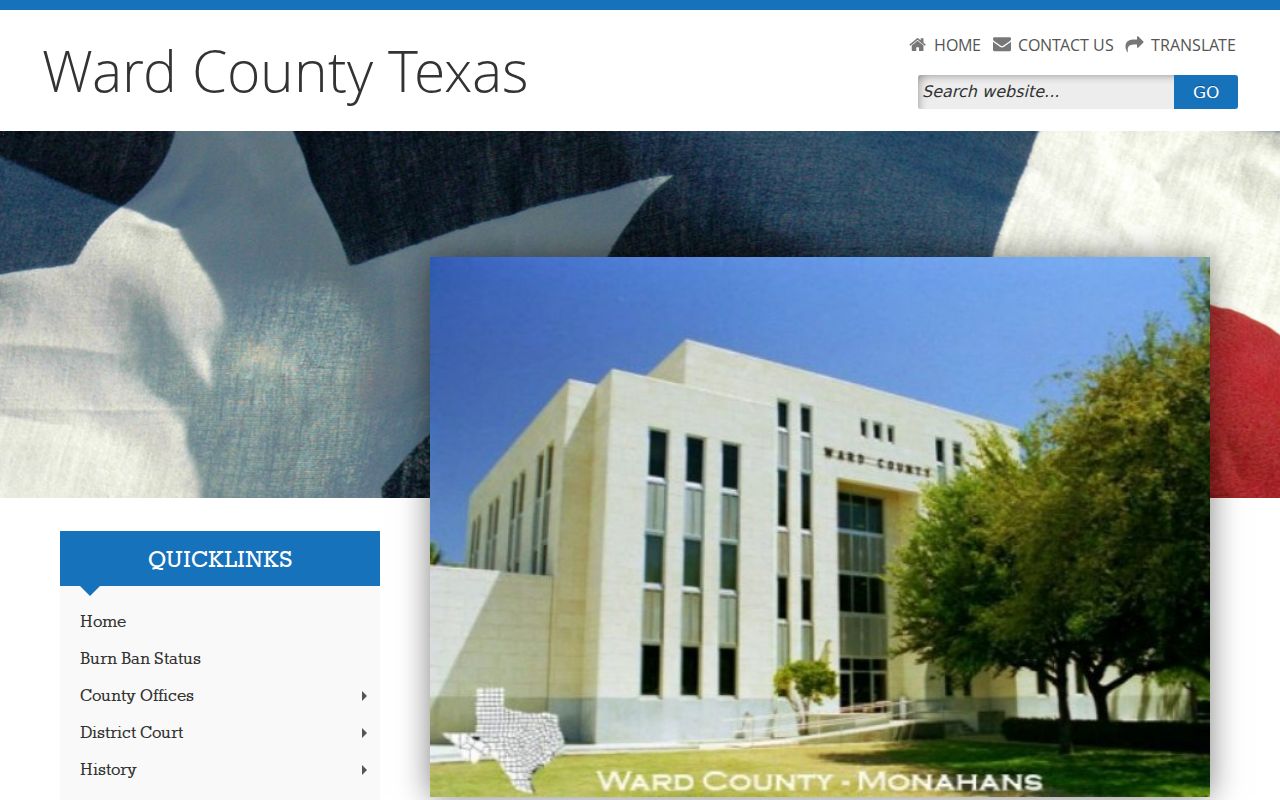
The image reinforces that Ward County criminal records are held by departments, not merged into one county name-search product.
Use the record’s creator as the first channel. A Monahans police narrative remains with the city even if the person later enters the county jail. A court clerk can provide the public case file, but cannot replace a DPS rap sheet. Likewise, a sheriff booking entry does not prove the final court result.
| Question | First Ward County channel | What it establishes |
|---|---|---|
| Is someone in local custody? | Sheriff or VINELink | Current custody or notification status |
| What did the arresting officer report? | Creating sheriff, police, or state agency | Incident narrative and arrest basis |
| What happened to a felony? | District Clerk | Filed charge, docket, disposition, sentence |
| What happened to a Class A/B misdemeanor? | County Clerk | County-court case and outcome |
| What does Texas publicly report? | Texas DPS name search | Limited conviction and deferred-adjudication data |
Texas Official Background Checks
The Texas Department of Public Safety Crime Records Division keeps the state Computerized Criminal History repository. Its public name product covers public Texas conviction and deferred-adjudication information submitted by criminal-justice agencies. It requires an account and credits. DPS states that each credit costs $1, with a 2.25 percent fee per credit and a $0.25 transaction fee. A no-match search still uses a credit. The mailed CR-42 search costs $10.
The DPS Criminal History Conviction Name Search is the official source shown below.
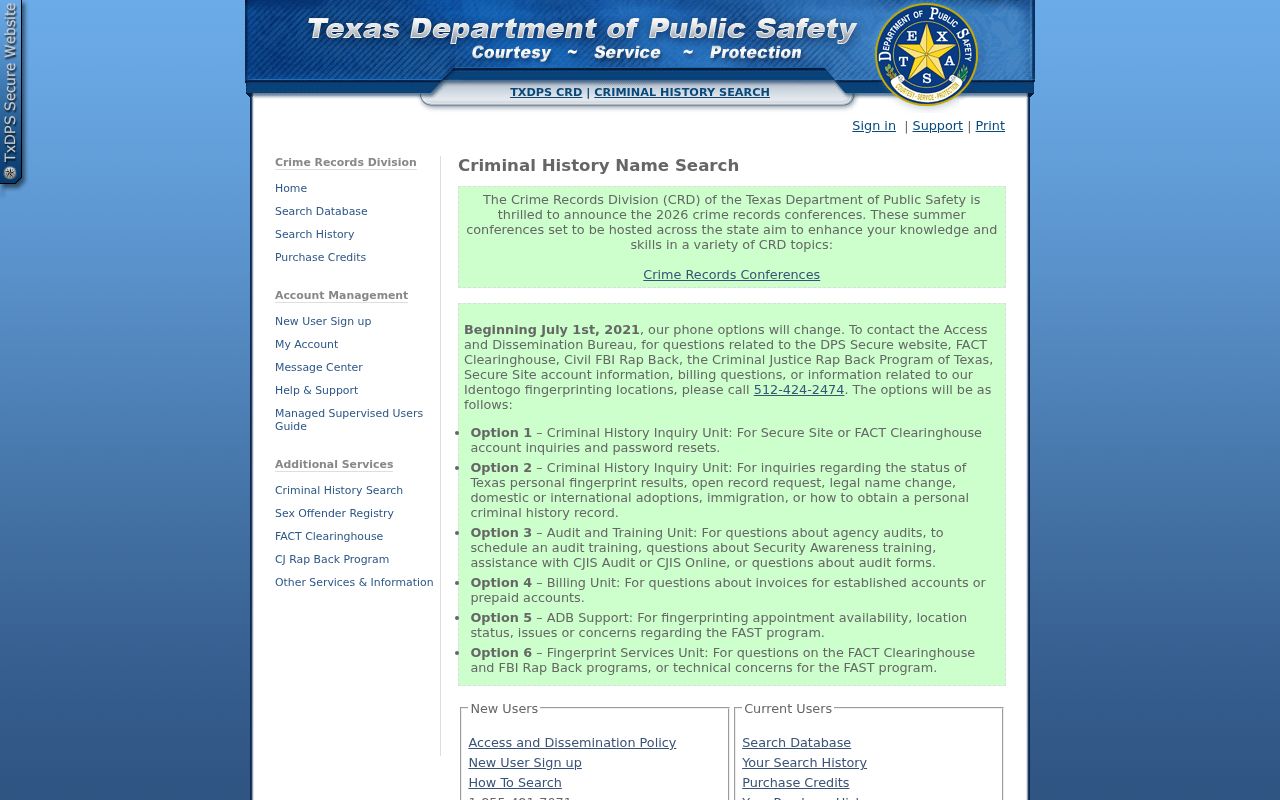
This public screen is a name-matching tool, not a full fingerprint-linked Ward County criminal record.
For self-review, DPS uses form CR-63 and fingerprints captured through Texas FAST, delivered by IdentoGO. DPS lists a $15 fingerprint record check plus a $10 FAST capture fee. Two hard cards at FAST cost $20. The FBI Identity History Summary is also subject-only and costs $18 through the direct federal channel. Neither product replaces the pleadings, orders, and financial entries in a Ward County court file.
| Official product | Published base cost | Main limit |
|---|---|---|
| DPS online public name search | $1 credit plus transaction charges | Name match; no-match consumes credit |
| DPS CR-42 mail search | $10 | Identifiers can yield several candidates |
| DPS/FAST personal review | $15 plus $10 capture | Subject fingerprint process |
| FAST hard cards | $20 for two cards | Capture only, not a record search |
| FBI Identity History Summary | $18 direct | FBI-held history, not local court papers |
Ward County DPS Match Risks
DPS uses Soundex to locate names that sound alike. That can help with spelling variants, but it can also surface a different person. Date of birth, middle name, sex, race, and other descriptors help narrow results. They do not turn a name search into fingerprint identification. Preview the candidate data first, and do not treat a similar name as proof that the Ward County arrest or case belongs to the subject.
The official DPS search-help page documents credits, matching choices, and previews.
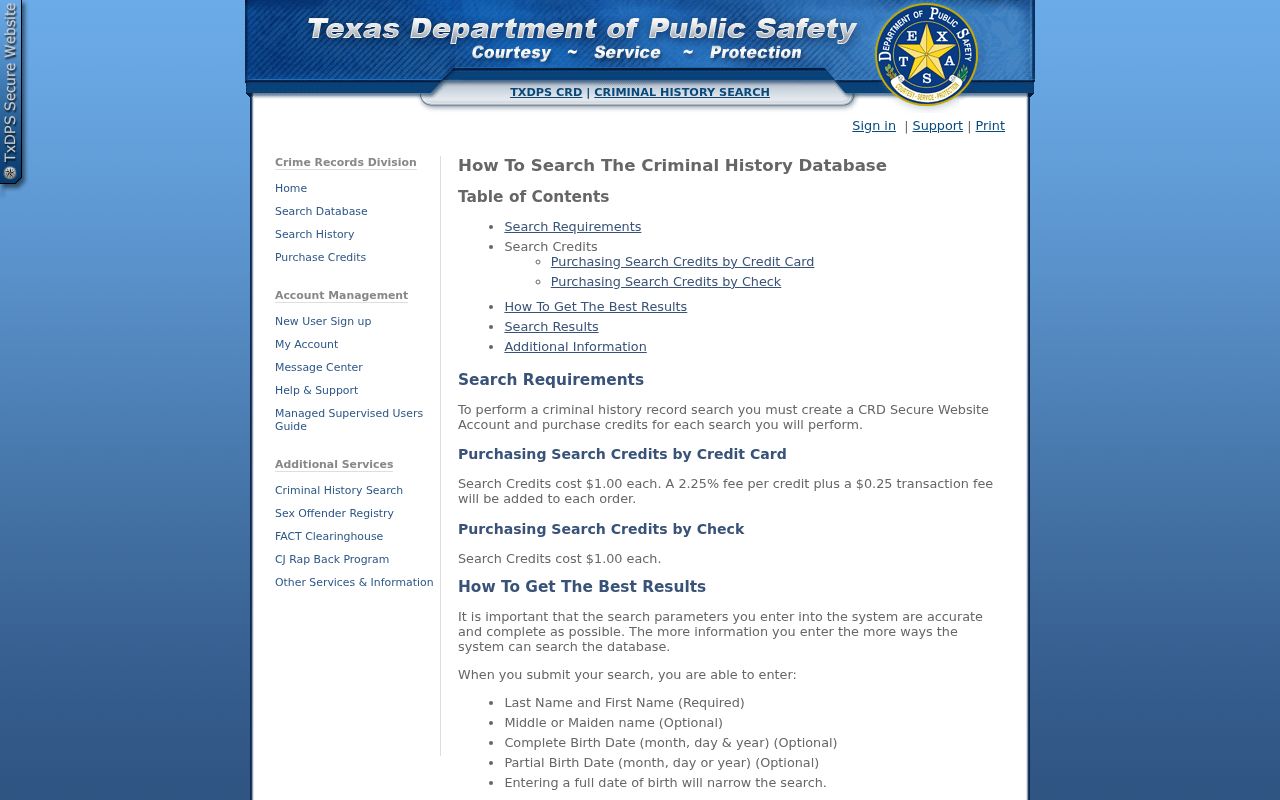
Its controls show why careful comparison is part of any responsible Ward County criminal record search.
| Field or control | Required | Use |
|---|---|---|
| Last Name | Yes | Supports exact or similar-sounding name matching |
| First Name | Yes | Uses the subject’s legal or known name form |
| Middle Name | Not specified | Helps narrow common-name candidates |
| Date of Birth | Optional, but important | Helps compare candidates without proving identity |
| Sex and Race | Not specified | Add descriptive filters |
| Exact Match | Optional | Changes exact versus broader matching behavior |
| Multi-Entry | Optional | Queues more than one search |
| Preview | Result control | Shows descriptive data before a credit is debited |
Note: A public DPS result should be checked against the originating Ward County court file before anyone relies on its outcome.
Ward County FAST Fingerprint Review
A fingerprint self-review is the strongest way to find missing dispositions, identity misuse, or arrest cycles that a public name result does not show. Begin with DPS form CR-63. Then schedule FAST capture and bring the applicable service code and accepted photo identification. No permanent Ward County enrollment address was confirmed in the research, so use the live enrollment system to see the current appointment locations rather than assuming a Monahans site.
The official Texas FAST enrollment portal provides the current appointment interface.
This fingerprint route ties the record to the subject more reliably than name similarity can.
DPS says the result takes about ten business days after receipt, apart from postal time. If the record lacks a Ward County disposition, contact DPS error resolution at 512-424-7256 and be ready to obtain the case outcome from the correct clerk. The clerk’s certified judgment or dismissal can supply what the state repository needs, but the local office and DPS perform separate parts of the correction.
Criminal Record Types
Ward County criminal history is a chain of records, not a single file. The arresting agency starts the account. The jail adds custody facts. A magistrate records the first judicial steps. The prosecutor’s charge and the clerk’s docket then show whether the allegation advanced, changed, or ended. DPS assembles fingerprint-supported arrest cycles and reported outcomes at the state level.
These terms keep the channels distinct:
- Incident or arrest report
- The creating agency’s account of allegations, observations, location, time, and arrest basis. It is not proof of guilt.
- Booking record
- The Ward County jail intake entry, which may show the received charge, booking time, agency, bond, and custody status.
- Magistration record
- The probable-cause, warning, counsel, and bail actions made after arrest under Texas procedure.
- Court case file
- The clerk’s docket, charging papers, orders, hearings, judgment, sentence, costs, and public documents.
- DPS rap sheet
- The statewide event history built from fingerprints and agency or court reports, with public access limited by law.
- Custody record
- The local jail, TDCJ, or federal locator entry for the system that currently or formerly held the person.
A registry record is another distinct public source. Texas DPS publishes defined registration fields and risk information while withholding protected identifiers and victim details.
Warrants also split by court. A felony capias may connect to a District Clerk case. Fine-only bench warrants or capias pro fine can remain with a municipal or justice court. Ward County publishes no official countywide warrant database, so confirm the issuing court and status before taking action.
Ward County Arrest, Case, and Rap Sheet Records
An arrest label can change before filing. The prosecutor may use a different count, a grand jury may return or decline an indictment, and the court may later dismiss, acquit, defer, or convict. For that reason, the Ward County criminal court case record supplies the outcome that a booking entry cannot. A dismissal ends the prosecution without a conviction, but it does not erase the booking or DPS arrest cycle by itself.
Oil-patch enforcement makes the distinction especially useful. A DPS trooper, sheriff deputy, or Monahans officer may create the report. Ward County Jail can hold the person. The County Clerk or District Clerk may then hold the filed case. The same event can therefore require calls to three offices, even though each office is responding about one incident.
Community supervision is another separate layer. The court judgment shows probation terms, while the 143rd Community Supervision and Corrections Department keeps operational supervision material. Parole decisions belong to the Texas Board of Pardons and Paroles, and the TDCJ Parole Division supervises releasees through its regional structure. An old notation should be checked against the current court and corrections record.
Inside a Ward County Criminal Record
The fields vary with the custodian. A court file can show counsel, judge, hearings, bond, motions, judgment, and financial entries that a rap sheet does not contain. DPS can hold a state identification number, fingerprint-linked cycles, and reported outcomes from many Texas agencies. Public views may suppress full birth dates and unique identifiers.
| Name & Identifiers | Legal name, aliases, date of birth, sex, race, and restricted SID or FBI identifiers where authorized. |
|---|---|
| Arrest / Booking Data | Event date, arresting agency, tracking or booking number, received charge, bond, and custody information. |
| Charges & Statutes | Offense description, Texas statute, charge class, complaint, information, or indictment. |
| Disposition | Conviction, dismissal, acquittal, deferred adjudication, no-bill, or another recorded outcome. |
| Sentence | Confinement, community-supervision term, fines, court costs, and restitution when ordered. |
| Custody / Supervision | Local jail, TDCJ, federal custody, probation, or parole information within the proper system. |
Protected victim or minor details, medical material, Social Security numbers, driver-license data, and account information can be withheld or redacted. A missing field may reflect a lawful access limit, a reporting lag, or the fact that the search is being run in the wrong system.
Ward County Courthouse Record Counters
The 1940 Ward County Courthouse has two key criminal-record counters. The County Clerk in Suite 101 holds Class A and B misdemeanor court files. Its posted hours are 8:00 a.m. to 4:30 p.m. Monday through Thursday and 8:00 a.m. to 4:00 p.m. Friday. The office warns that it is not required to perform general searches, apart from federal tax-lien searches, and it does not hold felony or traffic-ticket cases.
The District Clerk in Suite 202 holds felony and other 143rd District Court files. Some originals are stored with an off-site preservation company. Staff can request a stored file, normally returned in about one day, though volume and the vendor can affect timing. Call 432-943-2751 with the name, approximate filing year, and cause number if known before visiting.
Both counters are at 400 S. Allen Avenue in Monahans. County Clerk calls go to 432-943-3294 or 432-943-3295. Ask for the docket, charging instrument, orders, judgment, sentence, and certification only when needed. Official filings go through eFileTexas or U.S. mail, not fax or email, but a records-copy question should still be discussed with the clerk.
Public Access Laws in Texas
The Texas Public Information Act gives access to public information held by a governmental body, subject to exceptions. A narrow written request should identify the date range, event, names needed to locate it, record type, and preferred format. “Promptly” means as soon as possible under the circumstances and within a reasonable time. The familiar ten-business-day period often concerns a request for an Attorney General ruling, not a promise that every record will arrive in ten days.
Key Statutes:
Government Code Chapter 552 gives the public inspection and copy right, subject to stated exceptions.
Government Code Chapter 411 limits general criminal-history dissemination and authorizes the DPS public product.
Code of Criminal Procedure Chapter 55A sets the current Texas expunction rules.
Code of Criminal Procedure Chapter 62 governs registry duties, public data, and registration duration.
Send a request to the creator or custodian. The sheriff cannot release a Monahans police report it never made, and the clerk’s judicial case records follow the clerk’s inspection and copy process. Active-investigation information, juvenile files, protected victim data, and sensitive identifiers can remain withheld or redacted.
Ward County Oil-Patch Record Routes
Ward County’s I-20 corridor and energy roads place several law-enforcement agencies in the same small region. The practical result is split custody of records. A Texas DPS trooper keeps the trooper report. Monahans Police keeps reports created inside city limits. The Ward County Sheriff keeps deputy reports and local jail material. The court clerk holds the filed prosecution.
If the responding agency is unclear, begin with the event location and ask the sheriff which agency created the report. Police and incident records can be requested with a narrow date and time, exact location, report number if known, and the particular item sought. A report, supplement, CAD entry, 911 audio, and body-camera recording are distinct items and can have different access or redaction rules.
Crash records form a separate branch. Texas crash reports use the official TxDOT channel and are not criminal case files. For warrants, Ward County has no public active-warrant list. Call the sheriff for county surrender logistics, the District Clerk for felony-case context, the County Clerk for Class A/B cases, or the issuing municipal or justice court for a fine-only capias.
Sealed, Expunged, and Restricted Records
Texas uses expunction for the destruction or return of qualifying arrest records. Current petitions rely on Code of Criminal Procedure Chapter 55A, which replaced the older Chapter 55 framework in 2025. Eligibility can arise from an acquittal, pardon, actual innocence, identity misuse, or specified no-charge, no-bill, dismissal, specialty-court, and fine-only paths. A dismissal alone does not guarantee relief because the full arrest episode, pending counts, limits periods, and related convictions can affect eligibility.
An order of nondisclosure is different. It generally restricts ordinary public dissemination of an eligible deferred-adjudication or conviction record while preserving access for specified government and criminal-justice users. The Texas courts nondisclosure form library separates the available paths. Ward County filings start with the court that had jurisdiction, often through the District Clerk for a district-level expunction.
The statewide 2026 schedule shows district and county civil filing components of at least $350, plus $25 petition or hearing notice and $25 order notice for each recipient that cannot accept electronic service. Exemptions and other routes apply, so obtain a current Ward County quote. After an order, keep certified copies, confirm notice, allow agencies time to act, and use a fingerprint self-review to see whether DPS updated its record.
Ward County Jail and Custody Records
The combined Ward County Jail and Sheriff’s Office opened at 415 E. Monahans Parkway in 2025. Texas Commission on Jail Standards planning records identify the project as a 118-bed facility. Older Lee Russ Law Enforcement Center references at 300 E. 4th Street are historical and should not be used for a current visit.
The Ward County Sheriff publishes no online jail roster, daily arrest blotter, mugshot gallery, mobile app, or detailed static visitor instructions. For current custody, begin with VINELink, which the sheriff links, or call 432-943-6703. VINELink gives custody and notification information. It is not a full Ward County arrest history and does not replace the officer’s report or the court result.
Confirm the current visit method, accepted identification, mail format, funds channel, phone provider, booking identifier, and bond route with the facility before sending money or traveling. Once a person transfers to state prison, the Texas Department of Criminal Justice Inmate Information Search replaces the county jail channel. The broader Ward County arrest lookup process follows the report, booking, magistration, and later court file without treating an arrest as proof of guilt.
Ward County Federal Record Boundaries
Ward County lies in the Pecos Division of the U.S. District Court for the Western District of Texas. A federal criminal case appears in federal records, not in the Ward County clerk’s prosecution files. PACER exposes federal dockets, parties, events, and filed documents through an account. Access is generally $0.10 per page, with charges waived when quarterly use is $30 or less. Courthouse terminals permit free viewing, though printing can cost.
The official PACER service provides the federal case-access route.
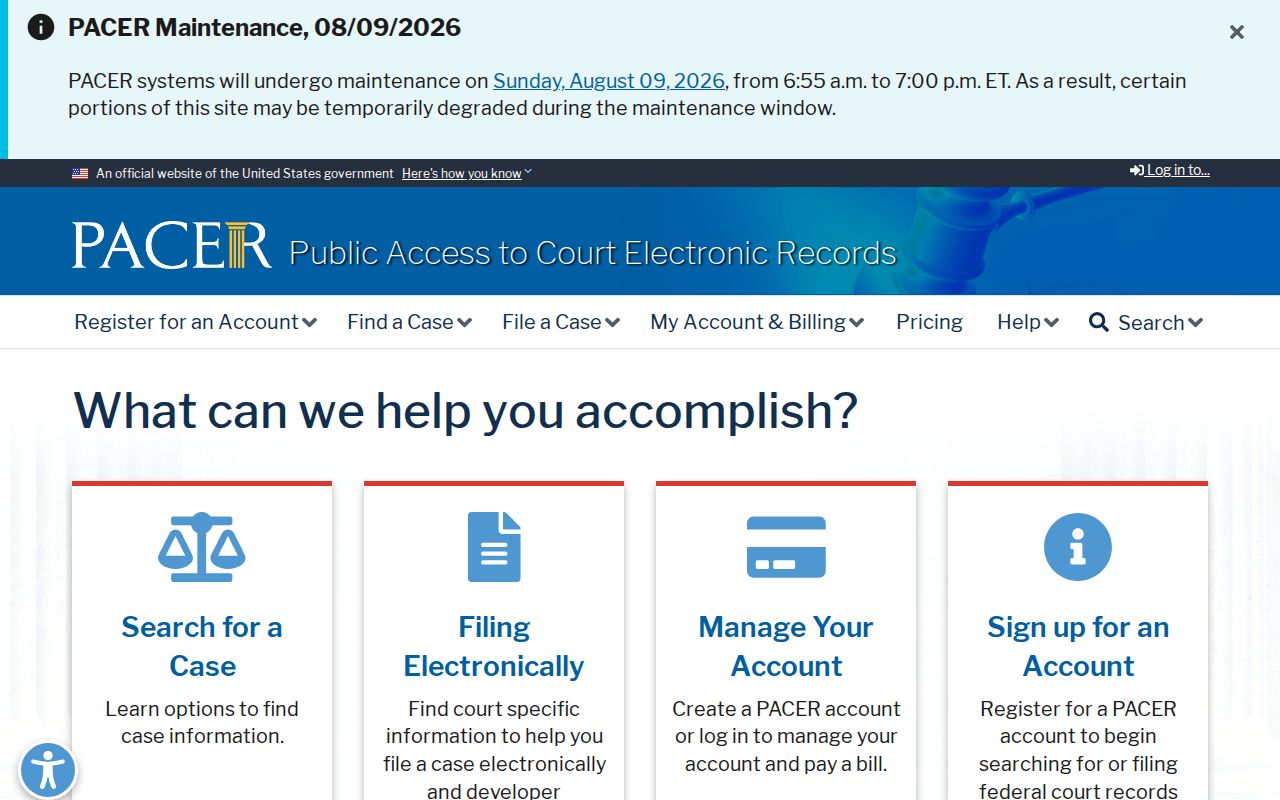
This federal docket layer should be checked only when the matter was prosecuted in federal court.
Federal custody also has its own locator. The Federal Bureau of Prisons locator searches by federal identifier or by name and descriptors.
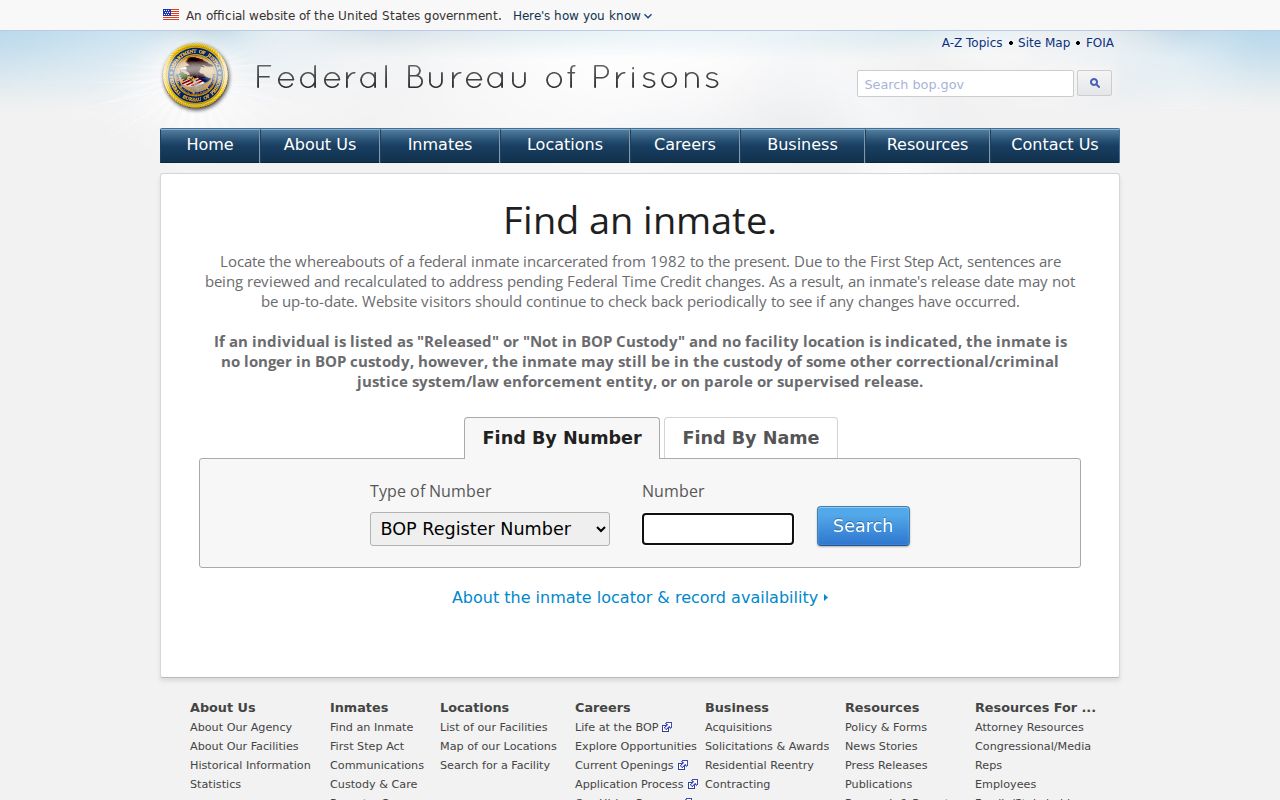
A released or missing federal result does not rule out custody in the Ward County jail or a Texas prison.
Ward County Criminal Records by City
The 2020 Census ranks Monahans, Thorntonville, and Wickett as Ward County’s three largest incorporated cities. Their local record paths differ. Monahans has a police records office and municipal court. Thorntonville has no verified separate police portal or current municipal-court portal, so readers must identify the responding agency and issuing court. Wickett has a municipal-court function but no verified online case search or separate police-record system.
Monahans Criminal Records
7,836 in the 2020 Census. City police reports, municipal cases, county booking, and higher court files use separate channels.
Thorntonville Criminal Records
561 in the 2020 Census. Start with the Ward County Sheriff and read the issuing court on any citation.
Wickett Criminal Records
498 in the 2020 Census. Municipal fine-only records and county custody records remain in different systems.